
 Volatility is usually framed as the enemy of income investors.
Market swings are described as risks to be avoided, endured, or waited out. During the accumulation phase, this framing is tolerable. Income is optional, time is abundant, and volatility is the price paid for long-term growth.
The income phase changes that relationship.
Once a portfolio is expected to produce cash flow, volatility feels different. Drawdowns coincide with withdrawals. Prices matter. Timing matters. And strategies that rely on selling assets often begin to feel unstable.
Yet volatility itself is not the real problem.
For disciplined income investors, volatility is often the pricing environment that makes sustainable cash flow possible.
Why Volatility Breaks Most Income Plans
The most common income strategy depends on selling assets to generate cash.
As long as markets rise steadily, this feels manageable. When volatility clusters, selling becomes emotionally difficult. Investors hesitate, underspend, or abandon plans entirely. Decisions degrade precisely when clarity is needed most.
The failure is not volatility.
The failure is forced decision-making during volatility.
An income strategy that requires selling assets places pressure exactly where investors are least equipped to handle it.
A more durable approach shifts income generation away from liquidation and toward cash flow produced internally by the portfolio.
What “Portfolio Income From Volatility” Actually Means
Generating portfolio income from volatility does not mean trading market swings or predicting direction.
It means recognizing that uncertainty has value—and that value can be monetized in defined, rule-based ways.
Volatility increases the price of risk transfer. Investors who are willing to accept clearly specified obligations can be compensated for doing so. That compensation often appears as option premium.
In this sense, volatility is not just risk.
It is pricing.
The challenge is not accessing volatility, but governing how it is used.
The Income Engines and Their Relationship to Volatility
Not all income sources respond to volatility in the same way.
Dividends
Dividends provide cash flow regardless of short-term price movement. They offer stability, but they are largely volatility-agnostic. Dividend income does not increase simply because markets become more uncertain.
Dividends can anchor an income plan, but they do not adapt dynamically.
Interest Income
Interest income offers contractual cash flow with relatively low volatility. Its behavior is driven more by interest-rate policy than equity market uncertainty.
Interest income provides ballast, not responsiveness.
Option Premium
Option income is where volatility becomes actionable.
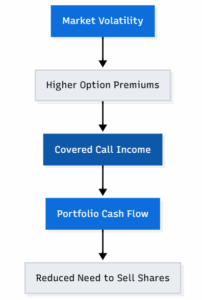
When investors sell options, they are compensated for accepting uncertainty on defined terms. Higher volatility increases option premiums. Lower volatility reduces them.
In income-focused portfolios, this most commonly takes the form of covered calls:
- Shares are owned intentionally
- Call options are sold against those shares
- Premium is collected as income
- Upside is capped above the strike price for a defined period
This structure converts uncertainty into cash flow. When volatility rises, income potential increases. When volatility falls, income moderates—without requiring asset sales.
Why Covered Calls Fail Without Discipline
Covered calls are often misunderstood as an income shortcut.
They are not.
They are governed tradeoffs.
Selling a call option means agreeing to sell shares at a specific price if assigned. If the investor is not emotionally prepared for that outcome, the strategy becomes a source of stress rather than stability.
The failure is not mechanical.
It is misalignment between intent and obligation.
When covered calls are applied only to shares the investor is genuinely willing to sell at the strike price, option income becomes a tool for converting volatility into predictable cash flow.
A Volatility-Responsive Income System
Income portfolios work best when designed as systems rather than reactions.
The objective is not to eliminate volatility.
The objective is to use it intentionally.
By converting uncertainty into income, investors reduce the pressure to make reactive decisions during market stress.
Common Volatility-Related Income Mistakes
Income strategies tied to volatility fail predictably when investors:
- Chase higher premiums without regard to risk
- Sell option strikes they are not prepared to honor
- Change rules mid-cycle as markets move
- Confuse income generation with risk elimination
Volatility does not disappear because income is being produced. What changes is how the investor experiences it.
Governance Turns Volatility Into an Ally
The difference between volatility as a threat and volatility as an income engine is governance.
Successful income investors define:
- Which assets are eligible for income overlays
- Acceptable strike prices and durations
- Position sizing limits
- Rules for action and inaction
- Conditions under which activity is reduced or paused
Without governance, volatility dictates behavior. With governance, volatility becomes a resource.
A detailed framework explaining how income-phase investors design portfolios that generate cash flow internally—rather than relying on routine liquidation—is outlined in a guide on earning portfolio income without selling shares, which connects volatility, option income, and behavioral discipline into a single operating model.
Final Thought
Volatility is unavoidable.
The real choice for income investors is whether volatility forces decisions—or funds the paycheck.
Portfolios designed to convert uncertainty into cash flow tend to be more resilient, more livable, and easier to manage across full market cycles.
The goal is not comfort.
The goal is control.