
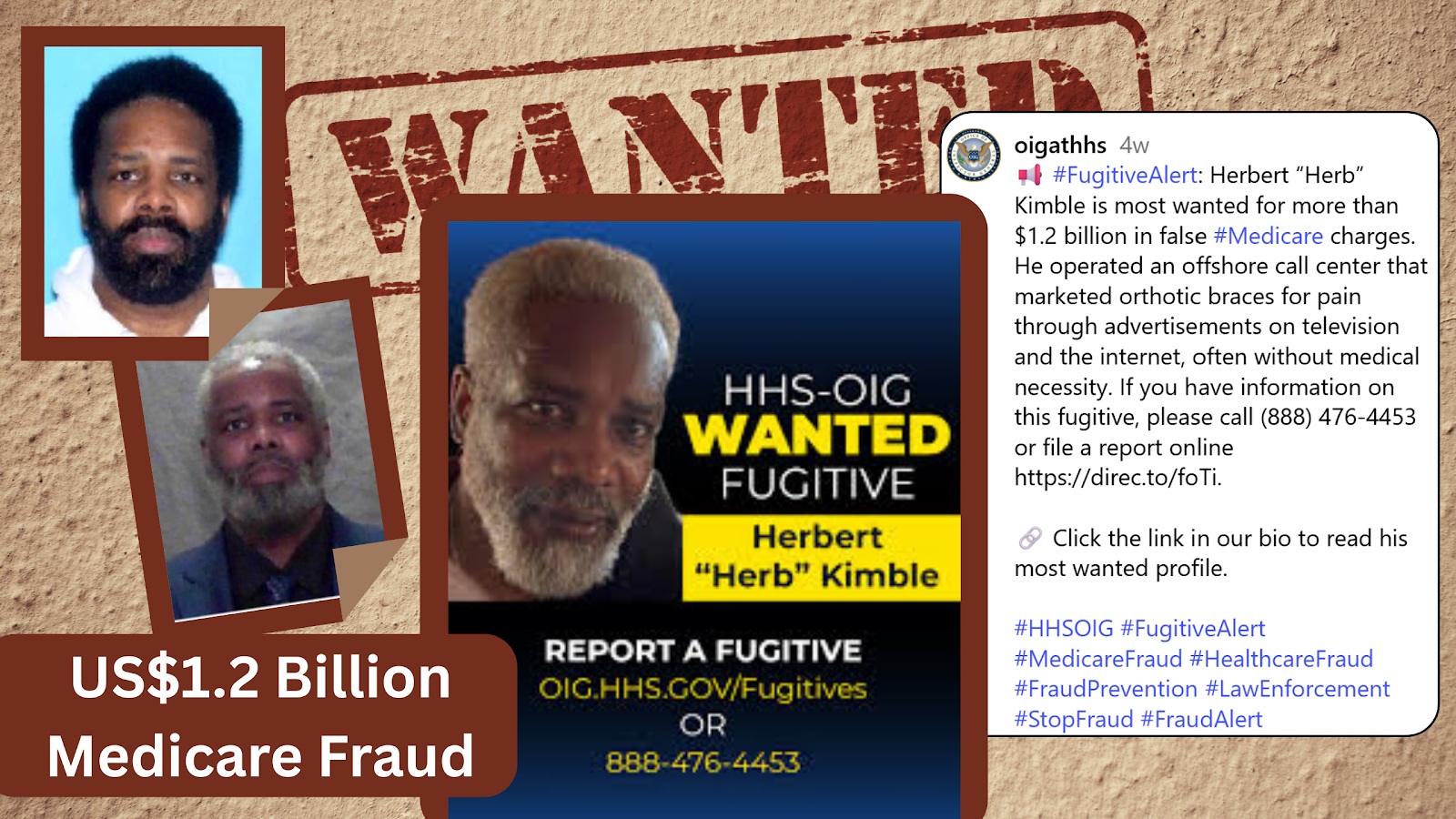
Washington, D.C. — The U.S. Department of Justice has detailed the role of Herbert “Herb” Kimble in Operation Brace Yourself, a vast Medicare fraud case that prosecutors describe as one of the most complex and costly health care frauds in American history. At the heart of the $1.2 billion scheme were offshore call centers, telemedicine physicians, and durable medical equipment suppliers that manipulated seniors into ordering unneeded braces.
Kimble, who pleaded guilty in 2019 but fled before sentencing in 2024, remains at large. Yet DOJ officials continue to emphasize his central role in the conspiracy, underscoring how his call centers industrialized fraud on a scale rarely seen.
“Herbert Kimble’s network was not a side player; it was the hub of the wheel,” said a DOJ prosecutor. “Without his call centers generating fraudulent leads, the scheme would never have reached such staggering losses.”
Anatomy of the fraud
DOJ filings provide a detailed description of how Kimble’s operation worked. His call centers, based primarily in the Philippines and South America, hired hundreds of telemarketers. They followed scripts emphasizing urgency, often telling seniors they were “eligible for free Medicare braces” and risked losing benefits if they declined.
Once Medicare numbers were obtained, calls were routed to telemedicine physicians who conducted brief consultations, sometimes lasting less than three minutes. Many doctors admitted they were paid per prescription. Invoices disguised these payments as “telehealth service fees,” though in practice they were kickbacks.
Kimble’s organization then packaged these prescriptions as “qualified leads” and sold them to durable medical equipment (DME) companies across the U.S. The DME suppliers billed Medicare at inflated rates, often charging more than $1,000 per brace. Profits were funneled back through a series of layered payments and shell corporations.
Court evidence showed that call center employees were trained to overcome objections. If a patient said they already had a brace, staff were instructed to reply, “Medicare will still cover an updated model at no cost.” In one intercepted email, a supervisor wrote: “Push harder on the seniors. Remind them they’ve earned this.”
Investigation timeline
The investigation into Operation Brace Yourself began in 2016, when CMS analysts flagged unusual spikes in orthotic brace claims. By late 2017, patterns suggested that a handful of telemedicine doctors were signing thousands of prescriptions, often clustered around call centers.
In 2018, whistleblowers came forward, reporting that physicians were being paid per prescription. Undercover agents began calling toll-free numbers advertised on television and online. Within weeks, they received their braces, which were delivered to their homes. These operations provided the DOJ with direct evidence of fraud.
Wiretaps and subpoenas soon followed. Investigators intercepted emails between Kimble’s managers discussing “volume targets” and “bulk orders” of braces. Bank records revealed tens of millions of dollars moving between call centers and U.S.-based DME companies.
In April 2019, the DOJ executed more than 80 search warrants in 17 states. The takedown led to charges against 24 defendants, including physicians, executives, and marketers. The DOJ called it one of the most significant coordinated healthcare fraud operations ever undertaken.
Case studies: the fraud ecosystem
The range of defendants illustrates the breadth of the scheme.
Florida DME Executive
One executive in Florida purchased thousands of prescriptions from Kimble’s call centers. His company billed Medicare for more than $50 million worth of braces. In 2021, he pleaded guilty and was sentenced to 10 years in prison, with the condition of repaying $23 million.
Texas Physician
A Houston doctor admitted to approving hundreds of prescriptions each week, many of which were written without reviewing the patients’ medical histories. He was sentenced to 30 months and barred from billing Medicare for the rest of his life.
Nevada Marketer
A marketing operator in Las Vegas ran a smaller call center that fed leads into Kimble’s larger network. She cooperated with prosecutors, providing testimony that helped convict others. In exchange, she received probation.
California Shell Operator
In Los Angeles, a DME executive laundered proceeds through shell companies. He forfeited $8 million in assets, including luxury vehicles and properties. His testimony revealed how financial layering was used to obscure kickback payments.
Together, these cases illustrate a network where every participant relied on Kimble’s call centers as the foundation.
Victim impact
The human toll was significant. Elderly Medicare beneficiaries across the country reported receiving braces they never requested. Many feared their benefits might be cut off if they refused deliveries.
In Ohio, a patient received three braces in a single month. “I didn’t know what was happening,” she said. “I thought if I said no, they’d cancel my Medicare.”
In California, a retired teacher described how she was called repeatedly until she agreed to a back brace. “It felt like harassment,” she said. “They wore me down.”
Advocacy groups argue that the fraud went beyond financial loss. “This is elder abuse disguised as telemedicine,” said a spokesperson for the National Council on Aging. “It erodes trust in health care at the moment seniors need it most.”
Legal framework
Kimble’s charges encompassed multiple statutes.
- Health Care Fraud (18 U.S.C. § 1347): criminalizes schemes to defraud health care benefit programs.
- Wire and Mail Fraud (18 U.S.C. §§ 1341, 1343): prohibits the use of communications and mail for fraudulent purposes.
- Anti-Kickback Statute (42 U.S.C. § 1320a-7b): forbids offering or receiving remuneration to induce referrals of federally reimbursed services.
Sentences for such crimes can range from 20 years to life imprisonment. Sentencing guidelines consider the amount of loss, the number of victims, and the leadership role. In Kimble’s case, prosecutors sought a lengthy sentence, citing his central role and the scheme’s extraordinary scale.
Forfeiture and restitution were also central. DOJ seized millions from related defendants, but officials acknowledged that only a fraction of the $1.2 billion loss will ever be recovered.
Parallel frauds
Kimble’s scheme bore resemblance to others, including significant Medicare frauds.
California Genetic Testing Case
Recruiters offered seniors free DNA kits, claiming to test for cancer risks. Physicians approved unnecessary orders, and labs billed Medicare. Losses topped $200 million.
Texas Fabricated Patient Records
A Texas-based DME company created fake medical files to justify claims. A whistleblower exposed the scheme, leading to multiple convictions.
Caribbean Call Centers
In 2022, the DOJ dismantled a Caribbean network that targeted U.S. citizens with fraudulent health insurance claims. The structure was nearly identical: telemarketing pressure, complicit doctors, and inflated billing.
These parallels reveal how fraud adapts to opportunities from braces to DNA kits to insurance.
Global enforcement challenges
Kimble’s offshore call centers highlight the difficulty of cross-border fraud. While U.S. law applies to Medicare billing, much of the telemarketing infrastructure was outside U.S. jurisdiction. DOJ relied on cooperation from foreign governments, but progress was uneven.
Mutual legal assistance treaties (MLATs) provided some tools for evidence collection. Yet extradition remains slow, especially when fugitives argue that they are being persecuted politically or have humanitarian concerns.
“Fraud has globalized,” said a DOJ official. “Our challenge is that enforcement remains national.”
Expert commentary
Legal experts and watchdogs stress that Operation Brace Yourself illustrates both the strengths and weaknesses of fraud enforcement.
“On the one hand, DOJ demonstrated it can dismantle billion-dollar networks,” said a Georgetown law professor. “On the other hand, the fact that Kimble fled shows systemic vulnerabilities in managing high-value defendants.”
A former DOJ prosecutor noted, “Allowing Kimble to remain free pending sentencing was a mistake. His disappearance complicates every related trial. It’s a lesson for future cases.”
Whistleblower advocates added that insiders are key. “Data can identify fraud, but testimony provides the context juries need. Without whistleblowers, these cases would stall.”
Policy reforms
In the aftermath of Operation Brace Yourself, CMS introduced prior authorization for specific orthotic devices. Predictive analytics were expanded to detect unusual billing patterns in real time.
Congress held hearings in 2020, pressing the CMS on why the 2017 red flags were not addressed until 2019. Officials cited resource shortages and technical challenges. Lawmakers pushed for more funding for fraud detection.
By 2021, the DOJ had established a cross-agency healthcare fraud task force explicitly focused on telemedicine. HHS-OIG also increased scrutiny of DME suppliers.
Yet experts caution that fraud evolves faster than oversight. “Every time a loophole closes, criminals look for another,” said a policy analyst.
Human cost and unfinished justice
The numbers tell only part of the story. Seniors who were manipulated into giving up personal data now fear identity theft. Patients who accepted unnecessary braces sometimes suffered physical harm, wearing devices they did not need.
One New Jersey patient reported that a brace caused sores on her leg. “I thought it was required, so I wore it,” she said. “Now I have medical bills from the damage it caused.”
For families, the fraud deepened distrust in Medicare. “My father stopped answering his phone,” said a Florida caregiver. “He thought every call was a scam.”
Prosecutors emphasize that, while the takedown was historic, justice remains incomplete as long as Kimble remains at large.
Conclusion
Operation Brace Yourself exposed vulnerabilities in Medicare on a massive scale. Herbert “Herb” Kimble’s offshore call centers industrialized fraud, exploiting seniors, corrupting physicians, and siphoning more than a billion dollars from taxpayers.
The DOJ’s breakdown reveals both the success of coordinated enforcement and the challenges that remain. Kimble’s guilty plea acknowledged responsibility, but his disappearance before sentencing highlights the fragility of accountability in global fraud cases.
“This case is far from over,” a prosecutor said. “Operation Brace Yourself was a milestone, but until fugitives like Kimble face sentencing, justice is unfinished.”