
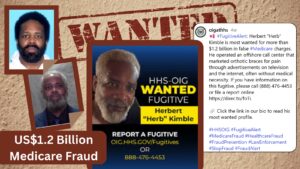
Washington, D.C. — The U.S. Department of Health and Human Services, Office of Inspector General (HHS-OIG), has named Herbert “Herb” Kimble a fugitive in connection with a vast health care fraud scheme that federal investigators say drained Medicare of more than $1.2 billion. The case, one of the largest in recent memory, involves offshore call centers, telemedicine providers, and durable medical equipment companies collaborating to exploit the vulnerabilities of Medicare reimbursement systems.
Kimble’s name now appears prominently on the HHS-OIG Most Wanted Fugitives list, a designation reserved for those who evade justice in major federal cases. According to the OIG’s fugitive profile, Kimble operated a large offshore call center that marketed medically unnecessary orthotic braces to Medicare beneficiaries. The braces were advertised aggressively on television and the internet, and when beneficiaries responded, they were persuaded to acquire the equipment through telemedicine consultations that investigators say lacked medical necessity.
A sophisticated call center operation
Court records and OIG filings show that Kimble’s call center was not a small operation but a highly organized, international enterprise. From 2014 to 2019, it employed telemarketers, information technology systems, and sales teams that collectively reached thousands of Medicare recipients each week. The call center obtained beneficiary data, coordinated with telemedicine physicians, and sold completed prescription packages to durable medical equipment (DME) companies.
Those companies then billed Medicare for braces and orthotics, often at inflated rates, while disguising the origin of the claims. According to the Department of Justice (DOJ), Kimble and his network capitalized on the growing role of telehealth and on gaps in Medicare’s oversight framework. The scheme flourished until April 2019, when federal investigators announced a sweeping takedown under the banner of “Operation Brace Yourself.”
“Telemedicine is a powerful tool, but in this case, it was exploited to defraud Medicare and taxpayers on a massive scale,” the OIG stated in its notice. “Herbert Kimble was at the center of a scheme that manipulated vulnerable patients and siphoned resources away from those who need legitimate care.”
The guilty plea and disappearance
In April 2019, Kimble pleaded guilty to charges that included conspiracy to defraud the United States, healthcare fraud, mail fraud, wire fraud, and paying kickbacks. Court documents confirm that he cooperated with investigators for several years, providing information about the network of co-conspirators. Yet his cooperation was not enough to spare him from sentencing.
On October 7, 2024, Kimble failed to appear in court for his sentencing. A federal bench warrant was immediately issued, and OIG added him to its fugitive list. His last known location was Manila, Philippines, though investigators have not disclosed further details.
The OIG describes Kimble as a man in his late fifties with experience in international business operations and telemarketing. His evasion highlights the challenges of extraditing U.S. fugitives from countries where formal extradition treaties are limited or enforcement is inconsistent.
The broader context of Medicare fraud
Kimble’s case is part of a larger pattern of fraud targeting the Medicare system. Federal officials have long warned that schemes involving telemedicine and durable medical equipment pose a particular risk because they allow fraudsters to generate high-dollar claims quickly and with relatively low upfront costs.
According to the Centers for Medicare and Medicaid Services (CMS), fraudulent DME claims have cost taxpayers billions of dollars over the last decade. In 2019 alone, CMS estimated that improper DME payments exceeded $1.3 billion. The government has since implemented tighter controls, but enforcement agencies acknowledge that fraud networks are adaptive.
Kimble’s fugitive status highlights the challenge of not only prosecuting fraudsters but also ensuring they face justice after conviction. “This is not just about recovering lost dollars, though that is significant,” an OIG spokesperson said. “It is also about accountability. When defendants like Kimble disappear, it erodes trust in the system and emboldens others who might be tempted to commit similar crimes.”
Case study: A parallel fugitive
To illustrate the scope of the problem, the OIG points to similar fugitives on its most wanted list. One case is that of Mubarak Hamed, who fled after being charged with diverting humanitarian funds to terrorist organizations. Another involves Brenda Rodriguez, who operated a fraudulent medical clinic that billed Medicare millions for services never rendered.
Both fugitives, like Kimble, leveraged systemic weaknesses and then sought to evade accountability. Their cases demonstrate that Medicare fraud is not confined to a single individual or even a single scheme. Instead, it represents a structural vulnerability that requires vigilance, technological monitoring, and cross-border cooperation to address effectively.
International flight and extradition challenges
Kimble’s last known presence in the Philippines raises complex questions about extradition. While the United States and the Philippines do have an extradition treaty, the process can be slow and subject to political considerations. Additionally, fugitives often move between jurisdictions to exploit gaps in enforcement.
The government has faced similar challenges in other cases. Extradition can take years, especially when defendants claim asylum, challenge the legality of the request, or attempt to establish new legal identities abroad. Kimble’s case may become another test of how effectively the United States can coordinate with foreign governments to return high-profile fugitives.
Operation Brace Yourself and its impact.
The 2019 takedown known as Operation Brace Yourself targeted 24 defendants across multiple states and countries. According to DOJ press releases, the operation dismantled an international telemarketing network that defrauded Medicare of more than $1.2 billion. Kimble’s offshore call center was one of the hubs of that network, providing prescription-ready leads that fueled fraudulent billing.
“The defendants paid doctors to prescribe medically unnecessary braces, which were then billed to Medicare,” DOJ Assistant Attorney General Brian A. Benczkowski said at the time. “This was a massive fraud that exploited vulnerable patients, siphoned taxpayer funds, and undermined trust in the health care system.”
While many defendants in the case were sentenced to prison, Kimble’s disappearance has prevented closure in his chapter of the investigation. His absence has also raised concerns about whether other conspirators might attempt similar evasions.
Case study: Durable medical equipment fraud in Florida
One illustrative example comes from a related case in Florida, where DME company owners were convicted of billing Medicare for millions of dollars’ worth of back and knee braces. Investigators discovered that the equipment was often left unused or discarded by patients who did not require it. In some cases, braces were shipped to beneficiaries who never requested them, with call center workers fabricating patient consent.
This Florida case illustrates how schemes like Kimble’s can ripple outward, involving multiple actors at various levels of the supply chain. The common denominator is the exploitation of Medicare’s reimbursement system, which historically has been vulnerable to false claims.
The human cost of fraud
Beyond financial losses, cases like Kimble’s have a human dimension. Elderly patients, often targeted by telemarketers, reported confusion and distress after receiving medical equipment they neither wanted nor needed. Some feared their Medicare coverage might be compromised or their personal information misused.
Patient advocacy groups have warned that these schemes can discourage the legitimate use of telehealth services for medical purposes. “When seniors associate telemedicine with fraud, they may avoid it even when it is appropriate and beneficial,” said a representative from the National Council on Aging. “That undermines public health.”
Toward stronger enforcement
Federal agencies have responded by tightening oversight. CMS now requires prior authorization for specific DME claims and has expanded the use of advanced data analytics to detect unusual billing patterns. Meanwhile, the DOJ has increased coordination with foreign partners through the Office of International Affairs.
Yet experts caution that enforcement is only part of the solution. Public awareness, patient education, and stronger whistleblower protections are also critical. Fraud thrives in the shadows, and one of the lessons from Kimble’s case is the importance of transparency and vigilance.
Case study: Whistleblowers as a tool against fraud
One of the most powerful tools in fighting Medicare fraud is the False Claims Act, which allows whistleblowers to file lawsuits on behalf of the government. In one recent case, a whistleblower exposed a DME company that was paying kickbacks for patient referrals. The company ultimately settled for millions of dollars, and the whistleblower received a percentage of the recovery.
Such cases demonstrate that insiders can play a crucial role in identifying and stopping fraud. However, whistleblowers often face retaliation, and advocates argue that stronger protections are necessary.
A timeline of fraud and enforcement
Herbert “Herb” Kimble’s rise as a central player in Medicare fraud did not happen overnight. Investigators pieced together a timeline that showed how the scheme escalated from modest beginnings to one of the most significant healthcare fraud cases ever prosecuted.
2014–2016: Expansion of call centers abroad.
Kimble established a network of offshore call centers, primarily in Southeast Asia, designed to reach U.S. seniors. Using inexpensive labor and aggressive scripts, telemarketers identified vulnerable Medicare beneficiaries, collected personal data, and seeded interest in medical braces and equipment.
2016–2018: Integration with telemedicine.
As telemedicine gained popularity, Kimble’s network adapted. Beneficiaries were directed to physicians who, in exchange for payments, issued prescriptions without meaningful evaluation. This innovation drastically increased the scalability of the scheme.
2018–2019: Peak fraud.
During these years, the network reached its zenith. DOJ estimates suggest that more than $1.2 billion in false claims flowed through Kimble’s call centers, with durable medical equipment companies serving as the final step in the chain. Beneficiaries reported receiving braces in the mail that they had never requested, while others received multiple deliveries in a single month.
April 2019: Operation Brace Yourself.
Federal agents executed coordinated arrests across multiple states. Kimble entered a guilty plea, admitting to conspiracy, wire fraud, and health care fraud. At this stage, it appeared the scheme would close with convictions and recoveries.
2019–2024: Cooperation and stalling.
Kimble provided limited cooperation with investigators. Yet as his sentencing approached, his behavior changed. Travel patterns shifted, communication slowed, and in October 2024, he vanished.
2025: Fugitive status.
Today, Kimble remains at large, raising questions about how a defendant in such a high-profile case could evade capture.
Case study: The Texas telemedicine ring
A related case prosecuted in Texas provides additional context for the scope of telemedicine-based fraud. In 2021, the DOJ charged executives at several telehealth companies for orchestrating a scheme that generated $300 million in false claims. Much like Kimble’s case, physicians often rubber-stamped prescriptions for equipment and genetic tests without actually seeing the patients.
The Texas case revealed how fraudsters exploit the convenience of telehealth. By presenting themselves as innovators, they gained access to both patients and investors. In reality, the system became a conveyor belt for unnecessary billing.
Comparing Kimble’s operation with the Texas case illustrates the systemic challenge: as telemedicine expands, so does the potential for misuse. Regulators now face the difficult task of promoting legitimate innovation while policing abuse.
The extradition dilemma
Kimble’s flight to the Philippines exposes the limitations of cross-border justice. Although the U.S. and the Philippines signed an extradition treaty in 1994, actual extradition proceedings can take years. Political considerations, evidentiary disputes, and procedural appeals can stall progress.
Experts note that fugitives often attempt to entrench themselves abroad. They may acquire residency permits, establish local businesses, or even try to gain citizenship through investment programs. Such tactics complicate extradition, as host countries may hesitate to hand over individuals who appear economically or socially integrated.
“Kimble’s disappearance is a classic example of the cat-and-mouse game that ensues when white-collar defendants flee,” said a former DOJ prosecutor. “They know that certain jurisdictions offer more legal cover, and they exploit that knowledge. But ultimately, fugitives live with a target on their backs. The system has a long memory.”
Expert commentary on systemic risk
Policy analysts argue that the Medicare fraud case involving Kimble reflects more profound weaknesses. Fraudsters identify inefficiencies and strike quickly. By the time oversight systems adapt, millions have already been lost.
“The Medicare reimbursement process was designed for efficiency, not fraud resistance,” explained a health care policy expert at Georgetown University. “That makes it vulnerable to schemes like Kimble’s. Once the loopholes are clear, networks scale rapidly. And because these crimes are financial and bureaucratic, they often go undetected for years.”
Watchdog groups say the lesson is clear: oversight must be proactive, not reactive. Advanced analytics, artificial intelligence, and cross-border data sharing are tools that can help identify fraudulent billing before it balloons into billion-dollar losses.
Case study: Whistleblower’s perspective
In one Medicare fraud case in California, a former billing specialist blew the whistle on her employer after discovering patterns of unnecessary prescriptions and inflated claims. The whistleblower described intense pressure from executives to “make the numbers work” regardless of patient need.
Her testimony revealed the mechanics of fraud: algorithms identifying high-reimbursement codes, scripts designed to manipulate physicians, and falsified patient records. Ultimately, her decision to come forward saved taxpayers an estimated $120 million.
Kimble’s case mirrors this pattern but on a larger scale. Insiders in his network could have detected the fraudulent practices, but without strong whistleblower protections and incentives, many may have remained silent.
A looming reputational crisis for telemedicine
Another consequence of Kimble’s scheme is reputational. Telemedicine, once hailed as a lifeline for rural and underserved patients, risks being stigmatized by association with fraud. Patients wary of scams may avoid legitimate telehealth services, reducing access to care.
Industry leaders are aware of the problem. Several telehealth associations have issued statements condemning fraud and calling for stronger vetting of providers. “We cannot allow bad actors like Herb Kimble to undermine trust in telemedicine,” one industry group declared. “This technology saves lives when used properly.”
Moving forward
The U.S. government’s pursuit of Kimble will continue, but the broader challenge remains: preventing the next billion-dollar fraud from happening. With Medicare spending projected to exceed $1 trillion annually by 2030, the stakes are high.
For now, Kimble’s name on the OIG’s Most Wanted list serves as both a warning and a symbol. A warning that fraudsters cannot count on escaping justice indefinitely. It is a symbol of the urgent need for vigilance in protecting taxpayer resources.
Conclusion
Herbert “Herb” Kimble’s fugitive status encapsulates the challenges of combating large-scale health care fraud in an era of globalized networks and digital technology. His scheme exploited Medicare, harmed patients, and cost taxpayers dearly. His disappearance underscores the difficulties of ensuring accountability when defendants flee overseas.
Yet his case also highlights progress. Federal agencies have become more sophisticated, data-driven, and collaborative in their efforts to combat fraud. Operation Brace Yourself demonstrated that international conspiracies can be exposed and dismantled. Now, the focus turns to bringing Kimble to justice and preventing similar schemes in the future.