
For many people, notarization feels like a quick administrative step. You show an ID, sign a document, and leave with a stamp that makes everything official. In New Orleans and across Louisiana, that expectation can collide with a more complex reality. Louisiana is a civil-law state, and its notaries operate differently from the notaries most Americans are familiar with. Add time-sensitive transactions, stricter compliance expectations, and growing demand for mobile access, and the simple act of finding a notary can become a bottleneck in legal and financial workflows.
The gap between what people assume and what the process actually requires often shows up at the worst time. It appears during a real estate closing, when a lender needs documents signed today. It appears when a family needs a power of attorney for hospital decisions. It appears when an affidavit is needed for an insurance claim, a school matter, or a court filing. In each case, the question is not just where to find a notary. It is whether the notarization will be completed correctly, on time, and in a way that the receiving institution will accept.
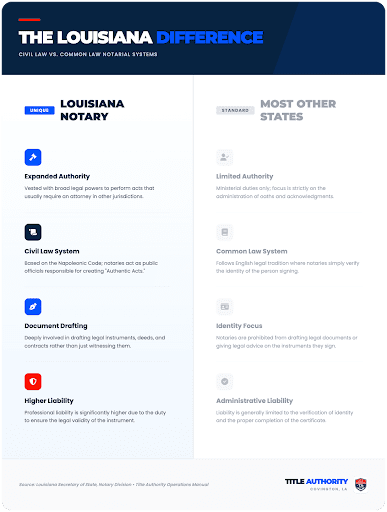
Louisiana notaries operate under a different legal model.
In many states, a notary public primarily verifies identity and witnesses signatures. In Louisiana, notaries have broader authority and are often involved in more consequential document execution. That difference matters because it raises the stakes of correctness. A document can be rejected because of a missing element, an improper witness setup, an incomplete form, or an identity verification issue. In practical terms, people moving to Louisiana or doing business here sometimes underestimate how state-specific notarization can be.
This higher bar also affects who can become a notary and the standards they must meet. Louisiana’s Secretary of State outlines the functions of the state’s notary division and the filing requirements for notary commissioning and compliance, including bonds and other official documents. One notable change is that Louisiana enacted a law increasing the required notary bond and personal surety amount from $10,000 to $50,000, effective February 1, 2026, reflecting the state’s commitment to financial responsibility in the role.
Why availability is now a core part of notarization
Even when a person understands what is needed, timing can still create friction. Notary needs do not always arise on a predictable schedule. Real estate transactions can compress quickly. Employers may require notarized forms for onboarding. Families may need legal authorizations outside standard business hours. When a document must be notarized today, the practical barrier is often not knowledge but access.
New Orleans adds its own logistical complexity. Traffic patterns, parking constraints, and the distribution of offices across neighborhoods can turn a simple appointment into a multi-hour block. For residents who work hourly, caregivers, and anyone coordinating multiple signers, the cost of time can be as real as the notary fee itself. These realities are a key reason mobile notary services have grown in importance, especially for signings involving multiple parties or limited mobility.
The United States has millions of notaries, yet people still struggle to find one when it matters.
At first glance, it seems like access should be easy. The National Notary Association reports that the number of notaries in the United States remains stable at about 4.4 million, underscoring that notarization is a significant, widely distributed function across industries and communities. That scale, however, does not guarantee immediate availability within a specific time window or for a specific document type, particularly in a market where many notaries operate as part-time professionals.
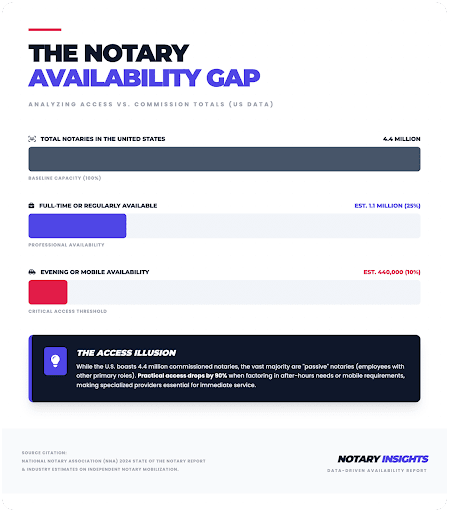
In New Orleans, the mismatch often comes down to timing and context. A person may know several notaries socially but still need an appointment late evening, at a hospital, or at a closing location with multiple signers. Access becomes less about the total number of notaries and more about the intersection of scheduling, travel, and the specific document’s requirements.
The most common cause of delays is document readiness, not the stamp
Many notarization attempts fail because the document is not ready. Missing pages, unsigned sections, mismatched names, incorrect dates, or unclear witness requirements can halt the process immediately. Even when a notary can travel to a signer, the appointment can still fail if a key participant is missing or if identification does not meet requirements.
In Louisiana, the readiness problem is often exacerbated by the expectation that the notary will resolve substantive issues. Notaries can help explain procedural requirements, but they cannot rewrite a contract on the fly or supply missing legal elements that should have been addressed earlier. This is why the most reliable notarizations tend to be those in which the signer arrives with a completed document, valid ID, and clarity on whether witnesses are required.
Why mobile services fit real life in New Orleans
Mobile notarization is not simply a convenience feature. In a city with varied work schedules and frequent time-sensitive transactions, mobility can be the difference between a process that moves forward and one that stalls. Mobile appointments are particularly common for hospital signings, elder care situations, and multi-signer transactions where coordinating travel is difficult.
From a consumer perspective, the advantage is less about luxury and more about reducing points of failure. When the notary meets the signer, it is easier to ensure all parties are present, IDs are on hand, and the signing environment is controlled. That can reduce repeat appointments and the cascading delays that occur when a document is rejected or incomplete.
A practical way to reduce surprises is to use clear local service explanations as a checklist.
One underappreciated reason people struggle with notarization is that they do not know what to prepare before scheduling. That is where a clear local checklist can prevent wasted time. Local service explanations that outline mobile availability and Louisiana compliance requirements help clarify expectations before an appointment is scheduled, such as this overview of New Orleans mobile notary public services.
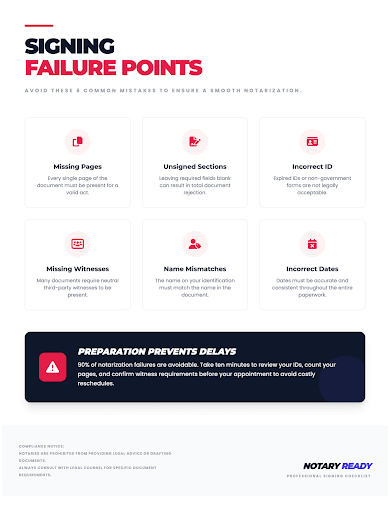
When consumers review a checklist in advance, they are more likely to confirm ID requirements, verify whether witnesses are required, ensure the document is complete, and select an appointment time that aligns with the transaction’s urgency. That preparation also helps notaries operate efficiently, which is critical when demand spikes during closing cycles or seasonal legal needs.
What this means for residents and businesses
Finding a notary in New Orleans is not only about locating someone with a stamp. It is about reducing transaction risk. In a civil law environment, the cost of a mistake can be more than an inconvenience. It can be a delayed closing, a rejected filing, or a document that must be re-executed under deadline pressure.
For individuals, the best results tend to come from treating notarization as a planned step rather than a last-minute errand. For businesses, it often makes sense to build notarization into process design, including contingency planning for after-hours signings and mobile needs. For anyone handling time-sensitive documents, knowing that Louisiana’s standards are distinct and that the state is raising compliance expectations through measures such as higher bond requirements is a reminder that the notary function is not a casual matter. It is a formal safeguard designed to protect the integrity of legal acts and the people who rely on them.