
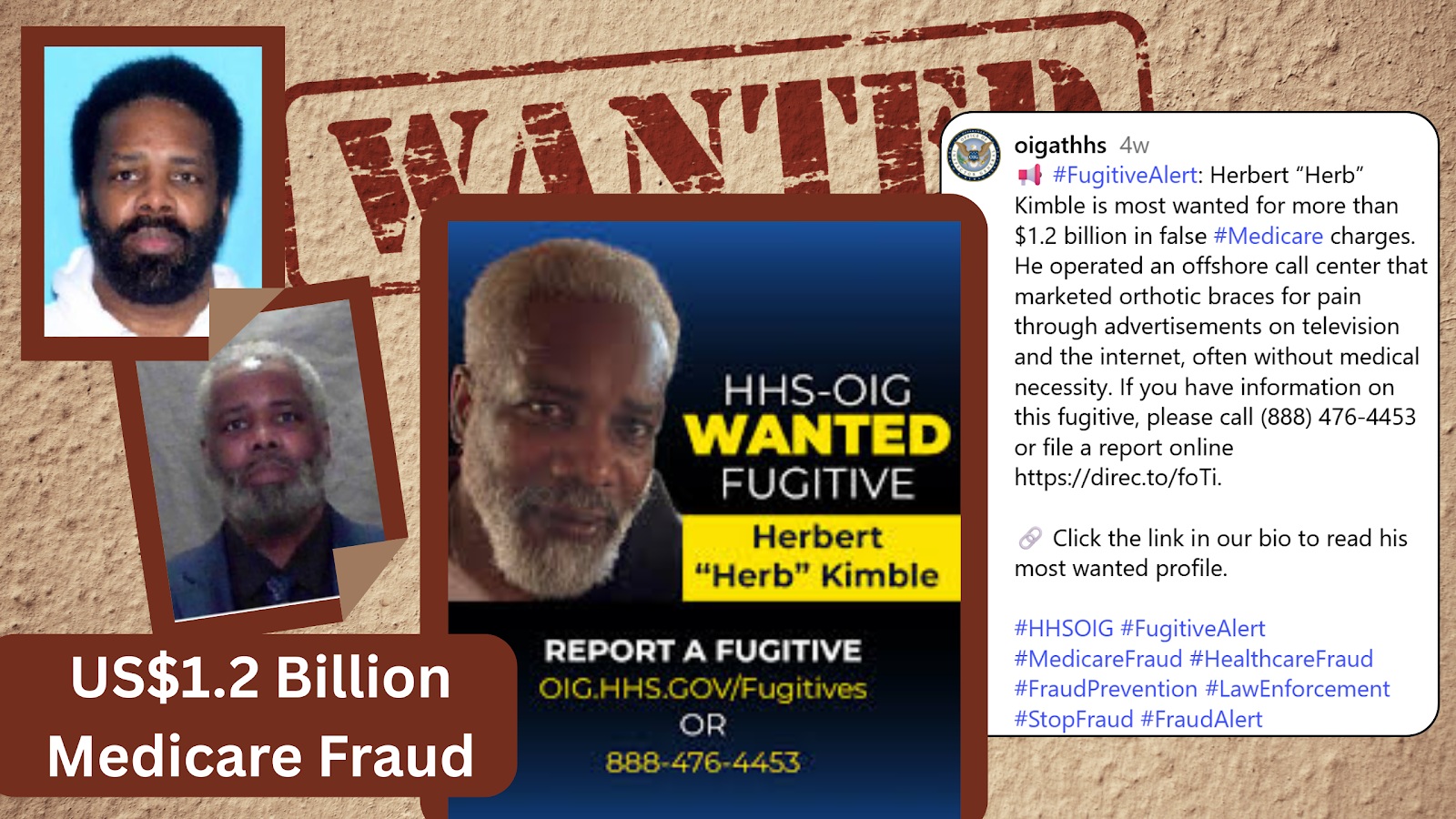
Richmond, Va. — A federal court has ordered the U.S. Department of Justice to provide a witness in ongoing trials connected to Operation Brace Yourself, despite the fugitive status of Herbert “Herb” Kimble, the offshore call center operator accused of playing a pivotal role in a $1.2 billion Medicare fraud scheme.
Judge Denise Page Hood of the Eastern District of Michigan issued the ruling in May 2024 after defense attorneys for co-defendant Sophie Toya argued that their client’s Sixth Amendment rights were being compromised by the absence of a central figure in the government’s narrative. Toya, a telemedicine provider accused of approving prescriptions without proper evaluation, insisted that the DOJ’s reliance on affidavits and summary evidence was inadequate.
“Defendants are entitled to confront evidence presented against them, even when a central actor is unavailable,” Judge Hood wrote.
The decision was a victory for Toya’s defense team and a reminder of the constitutional safeguards that endure even amid billion-dollar fraud prosecutions.
Background: Kimble’s guilty plea and disappearance
Kimble pleaded guilty in 2019 to conspiracy, health care fraud, wire fraud, mail fraud, and kickbacks. He admitted that his offshore call centers were designed to harvest Medicare numbers from seniors through aggressive telemarketing and then funnel that data into a network of telemedicine physicians and durable medical equipment suppliers.
Despite cooperating with investigators for several years, Kimble failed to appear for sentencing in October 2024. The court issued a bench warrant, and HHS-OIG placed him on its Most Wanted Fugitives list. His last known location was in Manila, Philippines. His disappearance complicated ongoing prosecutions, particularly those of individuals like Toya, who argued that without Kimble’s testimony or a comparable substitute, they were being deprived of their constitutional right to confront the government’s case.
Inside the courtroom
The May 2024 hearing stretched over two days, with Toya’s defense team pressing DOJ prosecutors on their reliance on “paper witnesses.” Defense counsel argued that summaries of call center operations and affidavits from investigators lacked the credibility that comes from live testimony. “A defendant cannot cross-examine a piece of paper,” Toya’s attorney told the court.
Prosecutors countered that producing witnesses for every element of a billion-dollar fraud scheme was impractical. “We cannot call every agent, every analyst, every investigator,” one DOJ attorney said. “The scope would overwhelm the trial.”
Judge Hood interrupted, asking whether a single credible witness with deep knowledge of Kimble’s role could be produced. The government conceded it could identify such an individual, likely a lead investigator or case agent. That exchange ultimately shaped the ruling.
The confrontation clause in practice
At the heart of the ruling lies the Sixth Amendment’s Confrontation Clause, which guarantees defendants the right to cross-examine witnesses against them. This clause, reaffirmed by the Supreme Court in Crawford v. Washington (2004), prevents testimonial evidence from being admitted unless defendants can challenge it directly.
The Crawford decision overruled earlier precedent that allowed reliable hearsay under certain conditions. It set a stricter standard: if evidence is testimonial, it cannot be admitted without cross-examination. Later rulings, such as Melendez-Diaz v. Massachusetts (2009), expanded this principle, holding that even laboratory reports in drug cases are testimonial unless analysts are available for questioning.
Applied to Kimble’s case, the precedent is clear. Affidavits about his role, absent cross-examination, cannot suffice. Judge Hood’s order reaffirmed that principle in the context of massive health care fraud.
Case study: Sophie Toya’s defense
Toya’s attorneys view the ruling as an opportunity. By questioning a government witness about Kimble’s operations, they hope to establish that Toya was misled. “Our client is not a mastermind,” her lawyer argued. “She was a telehealth physician who believed she was practicing within the law.”
Cross-examination is expected to focus on what Kimble told telemedicine providers about the legitimacy of his call centers. Did he present them as lawful marketing firms? Did he conceal the scale of the fraud? Such questions could distinguish between intentional fraud and negligent oversight.
Legal analysts note the strategy is high-stakes. If the witness admits Kimble misrepresented his operations, Toya could argue she lacked intent. But if testimony reveals she ignored obvious red flags, her defense could collapse.
Precedents in compelled testimony
Judge Hood’s ruling reflects a pattern of courts requiring government witnesses in fraud trials.
In 2017, a Medicare fraud trial in Florida turned when a case agent admitted, under cross-examination, that some claims in a DOJ spreadsheet were miscoded. The revelation reduced sentences for peripheral defendants.
In 2020, a whistleblower’s testimony in a genetic testing fraud trial in California revealed that physicians had been recruited under contracts that were misleading. The testimony proved pivotal for convictions but also highlighted the varied levels of culpability among defendants.
In 2022 in Texas, a whistleblower employee testified about fabricated patient records in a DME scheme. Her live account persuaded juries far more effectively than spreadsheets, underscoring why courts continue to demand human testimony.
In each case, compelled testimony reshaped the narrative. Rather than presenting fraud as monolithic, testimony exposed nuance, showing how roles and intent varied.
Balancing efficiency and fairness
Prosecutors argue that requiring witnesses in sprawling fraud cases strains resources. “Fraud cases generate mountains of data,” one DOJ prosecutor said. “We cannot put every agent and analyst on the stand.”
Yet defense attorneys counter that efficiency cannot override fairness. “If the government wants to accuse someone of a billion-dollar conspiracy, they need to put a human being on the stand,” one lawyer said.
Judge Hood’s order reflects the judiciary’s role in striking a balance. By requiring at least one knowledgeable witness, the court ensures fairness without overwhelming the trial with duplicative testimony.
Global context: fugitives and fairness
Kimble’s disappearance highlights the tension between holding fugitives accountable and ensuring fairness for co-defendants. In the UK, courts sometimes permit video testimony when witnesses are abroad. In Canada, limited hearsay is admissible if deemed reliable. The European Court of Human Rights emphasizes the importance of confrontation rights, but allows exceptions for witnesses who are unavailable.
Compared to these jurisdictions, U.S. courts adhere more strictly to the presentation of live testimony. Judge Hood’s ruling aligns with that tradition, emphasizing that constitutional protections remain paramount, even when fugitives complicate proceedings.
Expert commentary
Legal scholars emphasize the symbolic weight of the ruling. “The Confrontation Clause is not an inconvenience; it is a cornerstone of fairness,” said a University of Virginia law professor. “This ruling reminds prosecutors that justice is not just about efficiency but legitimacy.”
Prosecutors acknowledged the challenge but accepted the ruling. “We respect the court’s decision,” one DOJ official said. “Our focus remains on ensuring fair trials while continuing to pursue fugitives like Kimble.”
Whistleblower advocates see opportunity. “This could encourage DOJ to rely more heavily on insiders willing to testify,” said a whistleblower attorney. “Data is powerful, but testimony is persuasive.”
Broader implications for DOJ strategy
The Kimble ruling signals shifts in the DOJ’s approach. Prosecutors may now prioritize securing cooperating witnesses earlier in investigations to ensure they are available at trial. The case also raises questions about pre-sentencing detention. Allowing Kimble to remain free pending sentencing undermined related prosecutions. DOJ may push for stricter detention policies for high-value defendants.
Congress has taken notice. A 2025 committee hearing examined whether legislative reforms are necessary to prevent fugitives from derailing major fraud cases. Proposals include expanded monitoring, electronic surveillance, and asset freezes to make flight more difficult.
Some lawmakers have proposed the establishment of a fugitive recovery office dedicated to financial crime defendants, modeled after task forces for organized crime. “Mega-fraud cases require mega-fraud safeguards,” one senator said.
Victim perspectives
For patients, the courtroom debates may seem far removed, but the fairness of trials significantly shapes public trust. Seniors defrauded by Kimble’s network want accountability, but they also believe in fairness.
“I want people punished for what they did to me,” said an Illinois patient who received multiple braces. “But I also believe in fairness. If someone is accused, they should have the right to question the evidence.”
A caregiver in Florida echoed that sentiment: “My father stopped answering his phone because of scams like this. But he always taught me that fairness matters, even for people accused of crimes. That’s what separates us from the fraudsters.”
These voices remind the public that fairness is not abstract; it legitimizes outcomes for victims.
Policy reform and future outlook
The Kimble case has already influenced reforms. CMS has expanded its predictive analytics capabilities, enabling faster detection of billing anomalies. DOJ has increased international cooperation through task forces and information-sharing agreements. Lawmakers are exploring fugitive recovery registries and expanded extradition provisions for financial crimes.
Advocates argue that Kimble’s case is a warning: mega-fraud defendants cannot be treated like ordinary white-collar criminals. “When billions are at stake, and vulnerable patients are exploited, the stakes for accountability are too high,” said a Brookings Institution analyst.
Conclusion
Judge Hood’s ruling underscores that constitutional protections remain central even in the face of billion-dollar fraud schemes and international fugitives. By demanding live testimony, the court reaffirmed that fairness is inseparable from justice.
Herbert “Herb” Kimble’s fugitive status symbolizes unfinished accountability. Yet the courts’ insistence on transparency ensures that prosecutions continue with legitimacy. Operation Brace Yourself is not just a story of fraud and fugitives but of the resilience of the justice system itself.
“This case is not over,” a DOJ prosecutor said. “Kimble may be gone, but the pursuit of justice continues in the courts, for the victims, and for the integrity of Medicare.”