
Why missteps in identity change can destroy lives—and how to avoid them legally
VANCOUVER, B.C. — While thousands of individuals each year explore starting a new life abroad or erasing their troubled pasts, Amicus International Consulting warns that a startling number of people get it dangerously wrong.
From undocumented name changes to digital slip-ups that expose new identities, the mistakes people make when attempting to start over can lead to criminal charges, deportation, and even imprisonment.
“People often romanticize the idea of beginning again,” said a senior expert at Amicus International Consulting. “But a misstep in any jurisdiction—be it with immigration law, passport fraud, or biometric trails—can lead to irreversible consequences. Starting over isn’t just about fleeing; it’s about legally severing ties with the past and building a compliant, protected future.”
Amicus, a global leader in lawful identity transformation, is now issuing a comprehensive warning about the most common—and most dangerous—mistakes people make when trying to reinvent themselves.
THE TOP LEGAL MISTAKES PEOPLE MAKE WHEN STARTING OVER
- Attempting Fake Name Changes Without Court Orders
One of the most common mistakes is assuming a new name without going through the proper legal procedures. In many countries, using a name not legally documented in court can lead to criminal charges, including fraud and identity theft. - Acquiring Fraudulent Passports or Documents
People desperate to leave behind their identities often fall victim to black-market vendors who offer counterfeit documents. Not only are these passports illegal, but they also alert border systems and biometric databases. Possessing a forged identity document is a federal offence in most countries. - Choosing the Wrong Jurisdiction
Some believe that disappearing to a remote island or a non-extradition country makes them immune to consequences. However, countries that lack a strong identity infrastructure may also lack legal protections, meaning individuals are more vulnerable to exploitation, scams, or deportation. - Leaving Digital Breadcrumbs
Even after a name change, failure to manage one’s digital presence—such as email accounts, social media, and subscriptions—can immediately expose a new identity. Data brokers track everything. A careless login with an old email on a new device can be the unravelling point. - Not Rebuilding Financially
Many assume their new identity includes a new credit history and banking structure, but that doesn’t happen automatically. Without setting up financial legitimacy (including tax IDs, bank accounts, and proof of income), life under a new name quickly becomes unsustainable.
REAL CASE STUDIES: WHEN MISTAKES TURNED DANGEROUS
Case Study 1: The Teacher Who Vanished, Then Was Caught in Customs
A middle-aged teacher from the U.K., facing reputational damage after false accusations, purchased a fake Dominican passport through an online third-party vendor. Attempting to travel from Lisbon to Buenos Aires, her forged documentation triggered an Interpol alert. She was detained, deported, and now faces criminal proceedings in three countries.
Case Study 2: The Banker Who Forgot to Clean His Digital Trail
A financial consultant in Singapore legally changed his name and obtained residency in Paraguay. However, he continued to use his old Gmail account and retained his Dropbox account with financial documents under his former name. During a background check by a foreign bank, metadata led to the exposure of his information, freezing of his new accounts, and revocation of his residence permit.
Case Study 3: The Family Who Relocated Without Legal Help
A family of five from South Africa attempted to restart in Central America. They changed their names informally, moved without proper immigration guidance, and tried to enroll their children in school using forged documents. The school flagged the records, and the family was reported to immigration. The result: deportation, child services investigation, and lifelong bans from re-entry.
INTERVIEW: LEGAL EXPERT FROM AMICUS SHARES INSIGHT
To understand why people make these mistakes, we spoke with an Amicus legal compliance advisor who oversees client onboarding in over 40 jurisdictions.
Q: Why do people fail when trying to start over legally?
A: “Most people underestimate the complexity of global identity systems. They assume it’s just a name change or a move to another country. However, legal identity transformation also impacts immigration law, financial regulation, biometrics, data privacy, and occasionally treaty law. Without guidance, it’s incredibly easy to trigger red flags.”
Q: What should someone do first if they’re thinking of starting over?
A: “Consult with professionals. Determine what your legal options are. Are you eligible for a second citizenship through ancestry? Can you naturalize in a new country? Is there a legal pathway to erase digital traces? These are critical questions—and amateurs usually don’t know how to ask them.”
Q: Is it possible to rebuild legally without breaking ties completely?
A: “Yes, but selectively. Some clients retain access to their original identities for legal or family reasons but operate primarily under new ones. What matters is that both are lawfully documented and non-conflicting.”
HOW AMICUS INTERNATIONAL CONSULTING PREVENTS THESE MISTAKES
Amicus International Consulting has spent over two decades building lawful frameworks for individuals seeking to start anew, whether for safety, privacy, or personal transformation. With teams based in North America, Europe, the Caribbean, and Southeast Asia, Amicus offers comprehensive legal identity consulting services tailored to individual risk profiles and jurisdictional needs.
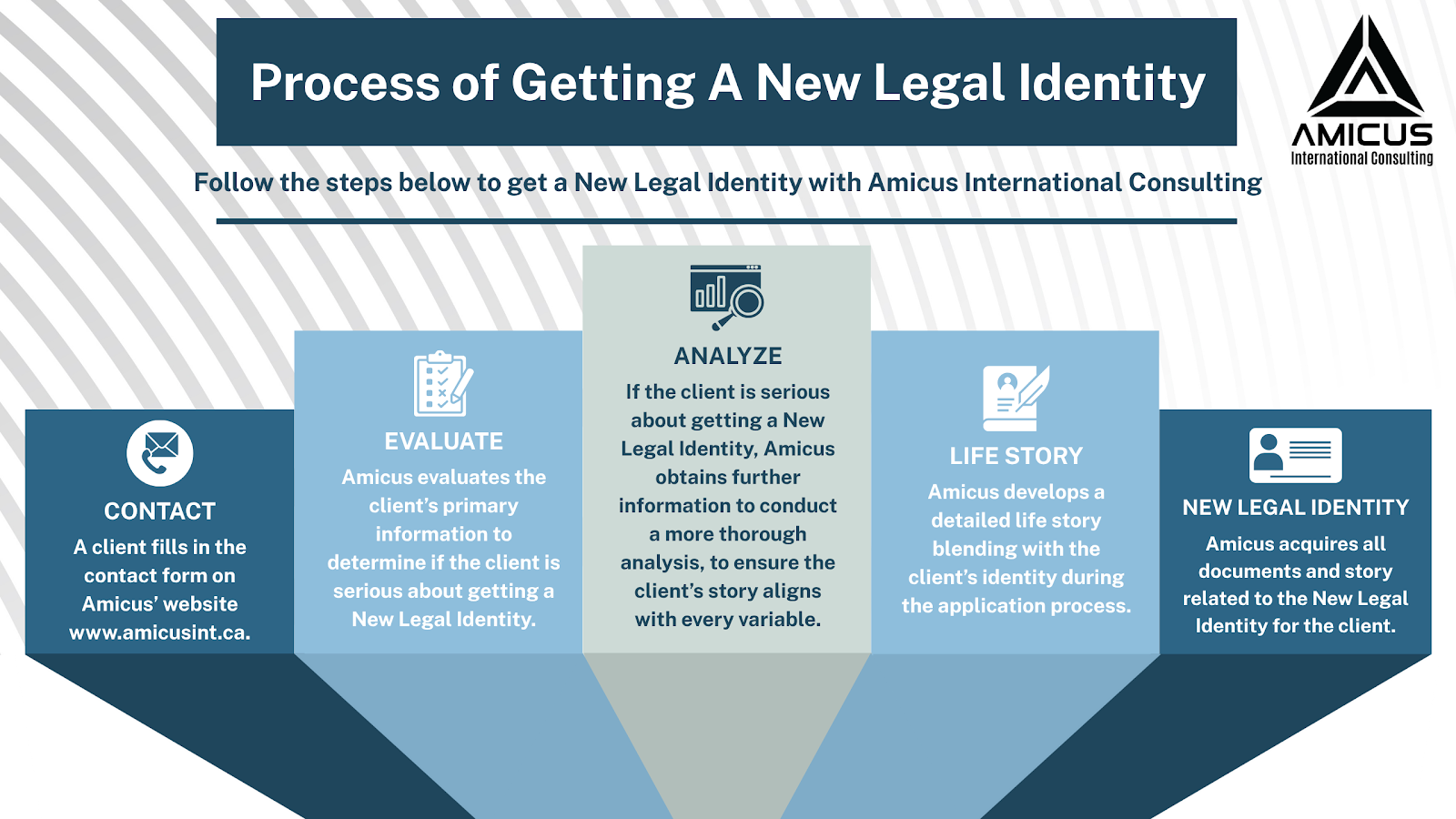
Their four-step process includes:
- Eligibility and Legal Risk Assessment
A full review of an individual’s current identity, nationality, legal obligations, and options under international law. - Jurisdiction Selection and Name/ID Structuring
Based on treaty law, national policy, and biometric risks, Amicus selects the ideal country for creating new identities while ensuring compliance with local documentation requirements. - Civil Registry and Citizenship Integration
Coordinating official name changes, birth certificate realignment, tax ID issuance, and, where appropriate, naturalization or dual citizenship. - Digital and Financial Erasure and Reintegration
Amicus guides clients in disconnecting from digital platforms, registering new financial institutions, and ensuring that banking and communication infrastructures reflect the new identity securely.
WHY PEOPLE SEEK NEW IDENTITIES IN 2025
In today’s global climate, reasons for beginning again legally vary:
- Survivors of domestic abuse
- Political refugees and dissidents
- Whistleblowers
- Victims of financial or reputational ruin
- Professionals exiting high-risk industries
- Families seeking protection from organized threats
While the reasons differ, the need for discretion, legality, and stability is universal.
THE COST OF GETTING IT WRONG
Starting over illegally or sloppily isn’t just about fines or detention; it’s about the consequences that follow. It can result in:
- Permanent travel bans
- Frozen assets
- Prosecution for document fraud
- Global blocklisting
- Damaged family safety
- Inability to ever rebuild trust or credibility
As Amicus warns, “The world is more connected than ever. But it’s also more traceable than ever. There is no room for error when rebuilding your identity.”
MOVING FORWARD: WHAT AMICUS RECOMMENDS
For those considering the path of identity reinvention:
- Avoid shortcuts. There are no safe “black market” solutions.
- Start with legality. Continuously pursue change through jurisdictions with established civil registry systems.
- Focus on integration. Ensure valid documentation, a digital presence, and a solid financial foundation support new identities.
- Get professional help. Legal teams, identity consultants, and digital erasure experts are not luxuries—they are essential.
CASE STUDY HIGHLIGHT: THE ENGINEER WHO STARTED OVER SUCCESSFULLY
After a wrongful lawsuit in Germany, a software engineer feared professional ruin. With guidance from Amicus, she pursued a name change in St. Kitts & Nevis through a citizenship-by-investment program. Today, she lives legally under a new identity in Asia, works in fintech, and retains access to her new identity without conflict with her past. Her digital footprint was scrubbed and reintegrated in a lawful manner.
FINAL WORDS FROM AMICUS
“There is no such thing as a ‘quick fix’ when it comes to disappearing or starting over,” says the legal advisor. “But there is a legal, safe, and structured way to do it. And we know how.”
For individuals exploring legal identity changes, Amicus International Consulting offers customized assessments, global compliance strategies, and comprehensive anonymity planning—all while adhering to the principles of international law.
Contact Information
Phone: +1 (604) 200-5402
Email: info@amicusint.ca
Website: www.amicusint.ca
Follow Us
LinkedIn: Amicus International
Twitter/X: @amicusint
Facebook: Amicus International
Instagram: @amicusint