
For many homeowners in 2026, the decision is no longer centered on finding a perfect house. It is centered on whether moving would solve enough problems to justify the cost, uncertainty, and disruption involved. That question has become especially relevant in markets where mortgage rates remain elevated, and replacement housing does not necessarily offer a better overall value proposition.
As a result, many households are turning back toward renovation. Among those projects, bathroom remodeling has emerged as one of the most practical alternatives to moving because it delivers a concentrated improvement in comfort and usability without requiring the financial reset of a home purchase.
Why the Stay-Put Strategy Is Gaining Ground
Housing conditions help explain why. The Indiana Business Research Center’s housing outlook points to a market where borrowing costs remain elevated, and relief for buyers is limited. In that environment, the stay-put strategy becomes more attractive. Homeowners who would once have responded to an outdated bathroom by scanning listings are now more likely to ask what can be improved inside the home they already have.
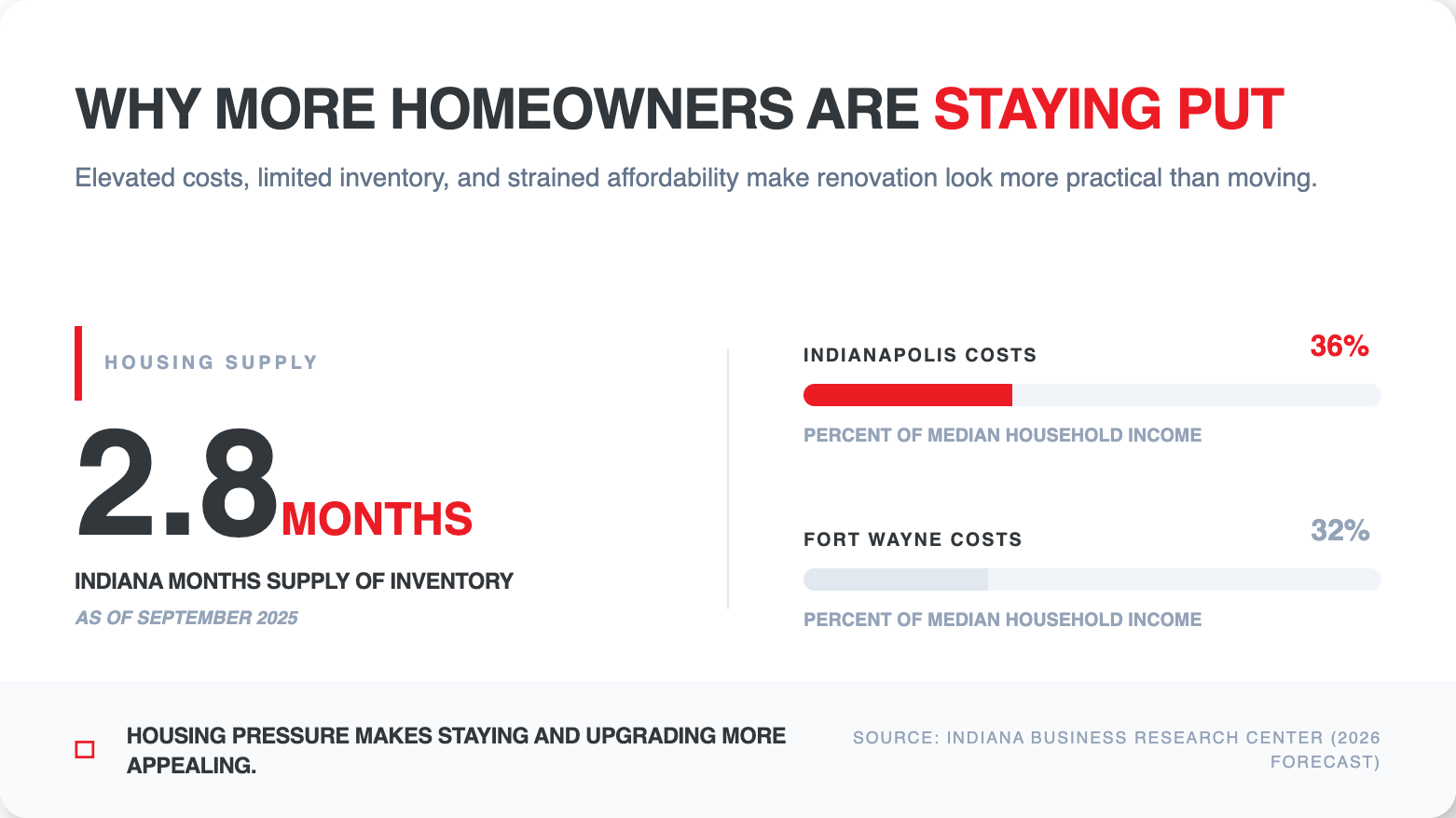
That shift does not necessarily reflect satisfaction with every part of the property. It reflects the idea that adapting a known home can be more rational than absorbing the friction of buying an unknown one.
Why Existing Home Value Changes the Equation
The financial side of the equation reinforces that logic. The Indiana home price index, tracked by FRED using FHFA data, has continued to grow, suggesting replacement housing may not feel substantially more accessible even for owners with equity. When borrowing remains costly, and values continue to hold, many households conclude that renovation is the better lever to pull.
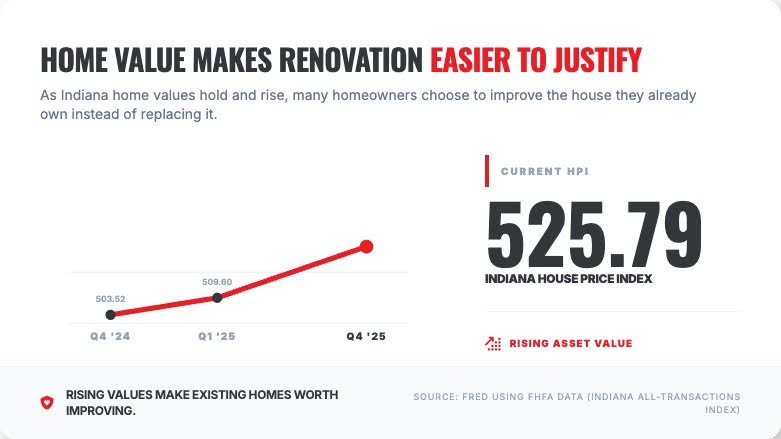
Bathrooms are particularly well-suited to this decision because they serve one of the most heavily used areas of the home. A remodel can create immediate quality-of-life gains while still supporting the broader perception that the property remains worth investing in.
The Frankfort Example Shows How This Trend Works in Practice
A recent local analysis, “Why Bathroom Remodeling Demand Is Rising in Frankfort, Indiana,” captured that logic in a market where homeowners tend to make measured decisions about property improvements. Frankfort is not a place where homeowners are widely driven by novelty for its own sake. The local trend points instead to a familiar pattern.
Families stay in the home they know, then begin addressing the rooms that create the most daily inconvenience. Bathrooms often rise first because the problems are repetitive and obvious. Poor lighting shows up every morning. Limited storage becomes a constant annoyance. A tub-or-shower configuration that once felt acceptable can start to feel inefficient or uncomfortable over time.
Bathrooms Deliver High Everyday Value
That local story reflects a national behavioral shift. Homeowners are spending more selectively, but they are still willing to move ahead when the project meets both emotional and practical tests. Bathrooms do that unusually well. Unlike some discretionary upgrades, they affect routine, cleanliness, privacy, comfort, and aging in place all at once.
Even a relatively contained remodel can change the everyday experience of living in the house. That makes the project easier to defend when households compare it against the transaction costs, moving expenses, potential rate increases, and the general unpredictability associated with relocation.
There is also a psychological dimension that matters. A move offers possibility, but it also introduces risk. Renovation allows homeowners to preserve the neighborhood they know, the commute they understand, and the maintenance history they have already lived with. That continuity carries value. It means a family can upgrade a weak point in the home without forfeiting everything else that already works.
Bathrooms often become the natural focus because they contain so much of what people want to improve first. Better storage makes mornings easier. Better surfaces make cleaning simpler. Better lighting improves visibility and comfort. A better layout can make the space feel larger even when the square footage stays unchanged.
Why Bathroom Remodeling Feels More Manageable Than Moving
Another reason bathroom upgrades outcompete moving is project containment. A homeowner does not need to transform the entire property to feel a meaningful difference. A bathroom remodel has clear boundaries, defined materials, and visible results. It can be scoped around the budget with more precision than many larger renovations.
For households trying to stay financially disciplined, that matters. The project feels manageable in a way that moving does not. Instead of reentering the market and renegotiating every housing variable at once, homeowners can solve one high-value problem within the house’s existing footprint.
Moderate-Value Markets Encourage Practical Renovation Choices
The Frankfort example also shows how market value interacts with the choice of renovation. In moderate-value communities, homeowners often make project decisions more carefully than in overheated markets. They want improvements that are proportionate, durable, and sensible.
A bathroom remodel fits that framework when it is centered on function rather than extravagance. Updating tile, vanities, lighting, storage, and shower design can make an older home feel more usable and better maintained without pushing the project beyond what the house or neighborhood can support. That balance is one reason bathroom projects often move forward when more ambitious plans are deferred.
Why More Homeowners Are Choosing to Upgrade Instead
What makes the current moment notable is that homeowners are not merely settling for renovation because they cannot move. Many are actively concluding that renovation is the smarter option. They already like the lot, the block, the school route, or the home’s overall layout.
The bathroom is simply one place where age and routine have exposed a mismatch between the house they have and the house they want to keep living in. By fixing that mismatch, they can stay in place with greater comfort and confidence. Under current market conditions, that can feel like a better form of progress than starting over in another property.
Conclusion
More homeowners are upgrading bathrooms instead of moving in 2026 because the math, the market, and the daily experience of living all point in the same direction. Borrowing remains expensive enough to make moving a heavier lift. Home values make existing properties worth protecting.
Older housing continues to present practical pain points that need attention. And bathroom remodeling offers a direct, contained way to improve a home’s performance. In that sense, the rise of bathroom renovation is not just a construction story. It is a housing-behavior story about how people adapt when staying put becomes the more rational path.