
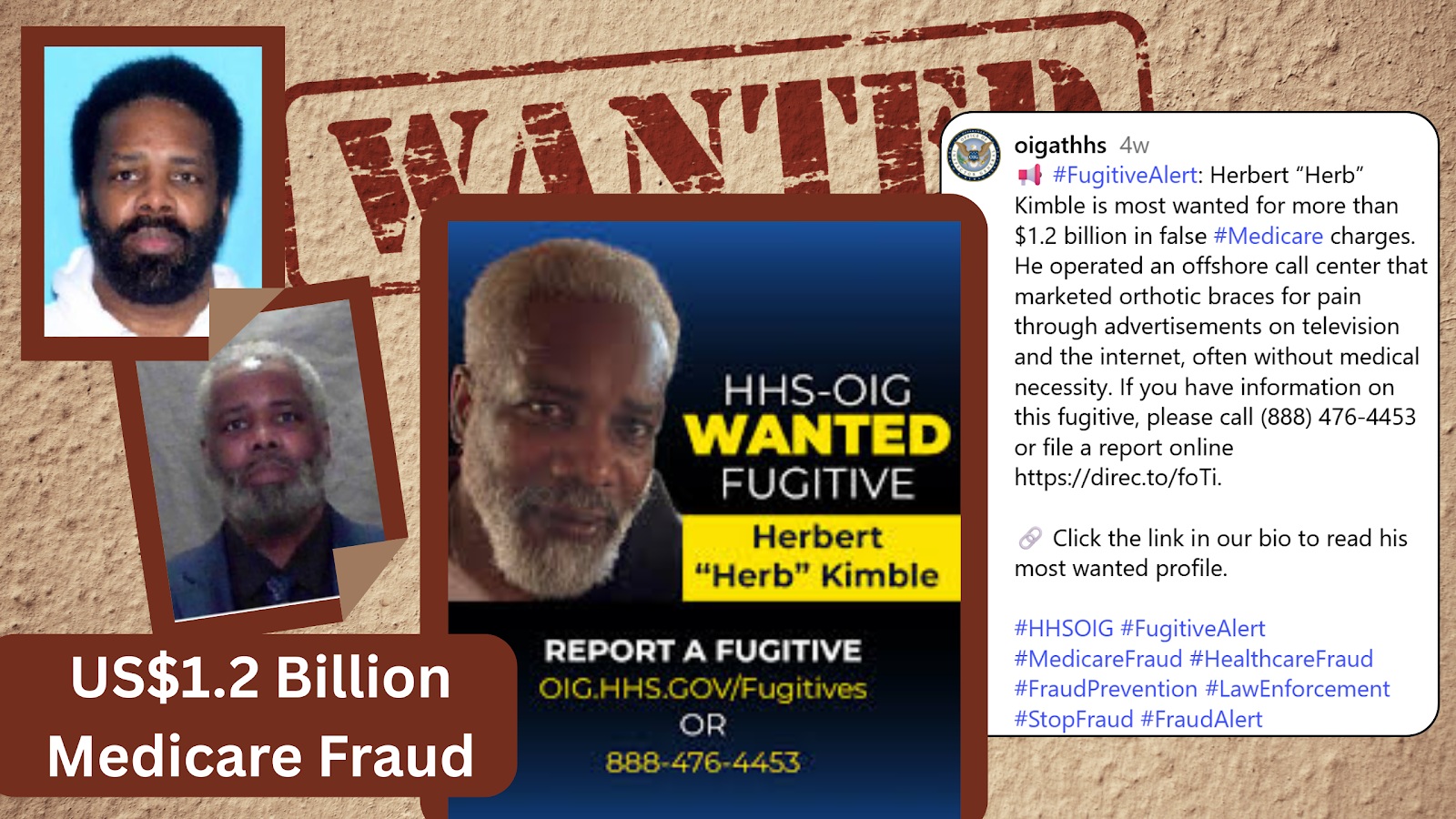
Washington, D.C. — Federal authorities have placed Herbert “Herb” Kimble on the HHS-OIG Most Wanted Fugitives list following his disappearance before sentencing in one of the most significant Medicare fraud cases in U.S. history.
Kimble pleaded guilty in 2019 to conspiracy, health care fraud, wire fraud, mail fraud, and kickbacks. His offshore call centers allegedly persuaded seniors to accept unnecessary orthotic braces, which telemedicine physicians approved with minimal review. Durable medical equipment companies billed Medicare, generating losses estimated at more than $1.2 billion.
Although Kimble cooperated with prosecutors for several years, he failed to appear for his sentencing in October 2024. A federal bench warrant was issued, and investigators confirmed his last known location as Manila, Philippines.
“Herbert Kimble was at the center of a scheme that manipulated vulnerable patients and siphoned resources away from those who need legitimate care,” the Office of Inspector General said in its fugitive profile.
Anatomy of the fraud
According to DOJ filings, Kimble operated offshore call centers that recruited hundreds of telemarketers. Seniors were bombarded with calls offering “free” Medicare-covered braces. Scripts instructed staff to emphasize urgency, often warning that benefits might be lost if patients declined.
Once Medicare numbers were secured, call center employees scheduled telehealth consultations. Physicians were paid per prescription, with some approving hundreds weekly without conducting meaningful evaluations. Durable medical equipment suppliers purchased these prescription leads, billed Medicare at inflated rates, and split proceeds through disguised “consulting” fees.
Investigators revealed that some physicians signed so many digital prescriptions in a single day that they could not possibly have reviewed the files carefully. Others admitted under oath that they had little idea who the patients were. This volume-driven model enabled Kimble’s network to expand rapidly, capitalizing on every weakness in the system.
The operation reached industrial scale. The DOJ estimated that Kimble’s network alone generated hundreds of thousands of fraudulent claims, resulting in Medicare losing more than $1.2 billion.
Victim impact
Patients described confusion and distress. Many received multiple braces that they did not request. Some feared they might lose Medicare coverage if they refused shipments. One Illinois patient said, “They made it sound like I had no choice. When it arrived, I left it in the box. I felt like my name was being used for something wrong.”
In Florida, an 82-year-old woman received four different braces in two months. “I could barely walk with them,” she told investigators. “I felt like someone was playing a trick on me.”
A widower in Ohio shared that he received multiple shipments of knee braces. “My wife had just passed away. I didn’t need any of this, but the calls kept coming. It felt predatory,” he said.
Patient advocacy groups stressed the psychological harm. Seniors already facing mobility challenges reported feeling humiliated when braces arrived uninvited, as if their conditions were being exploited for profit. Others worried that their Medicare numbers had been compromised and that further identity theft might follow.
The National Council on Aging called the Kimble case “a textbook example of elder exploitation.” “When older adults associate telemedicine with scams, they avoid it even when it’s medically necessary,” the group warned in a 2021 report.
Investigation timeline
The fraud first drew attention in 2016, when Medicare analysts detected a surge in billing for orthotic braces. By 2017, whistleblowers had alerted authorities to overseas call centers allegedly tied to the claims.
In early 2018, undercover agents began calling advertised toll-free numbers. Within weeks, they received braces through Kimble’s network. Agents also posed as physicians, uncovering kickback arrangements where doctors were offered $25 to $50 per prescription.
Wiretaps and email subpoenas confirmed the scope of the investigation. Investigators intercepted communications in which Kimble’s employees discussed “maximizing brace packages” and “stacking approvals.” Financial records revealed millions of dollars flowing through shell corporations registered in Delaware, Belize, and the Philippines.
The April 2019 takedown, dubbed Operation Brace Yourself, involved more than 80 search warrants executed across 17 states. The DOJ described it as one of the largest coordinated healthcare fraud busts in history.
Systemic weaknesses
Kimble’s case exemplifies how fraudsters exploit systemic gaps. Medicare’s reimbursement model was designed for efficiency, not fraud resistance. Durable medical equipment has long been vulnerable because claims are high-dollar, relatively low-risk, and often approved automatically.
The Centers for Medicare and Medicaid Services estimated more than $1.3 billion in improper DME payments in 2019 alone. While reforms have since introduced prior authorization and enhanced data analytics, the lag between fraud detection and enforcement allows schemes to flourish for years.
“Kimble’s operation thrived because oversight was reactive,” a health policy analyst at Georgetown University explained. “By the time patterns were flagged, hundreds of millions were already gone.”
Congressional hearings in 2020 revealed further lapses. Lawmakers pressed CMS officials on why predictive analytics flagged unusual billing as early as 2017, but enforcement did not occur until 2019. Officials cited resource shortages and the difficulty of distinguishing fraud from legitimate spikes in care delivery.
Case studies of other fugitives
Kimble joins a roster of fugitives on the OIG Most Wanted list.
- Brenda Rodriguez operated a fraudulent medical clinic in Texas, billing Medicare for services never rendered. She fled before trial and remains at large.
- Mubarak Hamed diverted humanitarian funds to terrorist organizations. He fled the U.S. in 2015 and eluded capture for nearly a decade.
- Ramesh Patel, a pharmacy owner, fled to India after being charged with billing Medicare for compounded creams that were not medically necessary. He was eventually extradited, but only after five years of diplomatic negotiations.
- Carlos Hernandez, a DME executive, disappeared after a $90 million fraud indictment in California. He was apprehended in Mexico in 2021, but his capture required cooperation across three jurisdictions.
- Anna Lopez, a home health agency manager, was arrested in Miami after 11 years on the run in Central America. She had been convicted in absentia of a $40 million scheme.
Each case illustrates the same challenge: fugitives use time, resources, and geography to their advantage. Yet they also show persistence pays off. Eventually, most fugitives are caught, even if justice is delayed for years.
Extradition challenges
Extraditing Kimble may take years. Although the U.S. and the Philippines share a treaty, appeals and political factors complicate the process. Defendants often argue that charges are political, claim asylum, or leverage business investments to strengthen local ties.
Historical precedents show the difficulty. In a 2010 case, a New Jersey pharmacy owner accused of fraud fled to Eastern Europe. Extradition took three years, during which the co-defendants had already served their sentences. In another case, a Texas fraudster lived openly in Mexico for nearly a decade before extradition proceedings concluded.
“Financial crime fugitives are among the hardest to extradite,” said a former DOJ prosecutor. “They have resources, networks, and time. But history shows that most are eventually caught.”
International comparisons offer perspective. The UK’s Serious Fraud Office often uses video testimony when it is not possible to return fugitives to face trial. Canadian courts permit limited hearsay evidence, prioritizing fairness and balance. The European Union relies on arrest warrants but struggles when suspects cross outside its jurisdiction. The Kimble case tests the resilience of U.S. extradition processes in a globalized world.
Expert commentary
Prosecutors stress that Kimble’s absence does not derail accountability. “Operation Brace Yourself was a success, but until fugitives like Kimble face sentencing, our work continues,” one DOJ official said.
Legal scholars emphasize the symbolism of his fugitive status. “When a cooperating defendant disappears, it undermines trust in plea agreements and raises questions about bail practices,” a University of Virginia law professor noted. “Courts may move toward detaining more high-value defendants until sentencing.”
Whistleblower advocates argue that insiders remain vital. “Data can identify fraud, but testimony provides the context juries need,” said a whistleblower attorney. “Without insiders willing to speak, billion-dollar cases like Kimble’s are harder to prosecute.”
Defence attorneys warn that Kimble’s flight may influence future trials. “Jurors may assume guilt by association,” one lawyer said. “That complicates the fairness of ongoing prosecutions against co-defendants.”
Policy implications
Kimble’s case highlights urgent lessons. The DOJ may reconsider how it manages plea agreements, potentially restricting the release of high-level defendants. CMS will likely continue tightening oversight of telemedicine and DME claims. OIG may push for expanded international cooperation on fugitives, potentially creating registries for financial crime fugitives akin to INTERPOL Red Notices.
Some lawmakers have already proposed legislation requiring stricter monitoring of defendants post-plea, including electronic monitoring and travel restrictions. Others are exploring enhanced asset freezes to prevent fugitives from sustaining themselves abroad.
Think tanks recommend creating a cross-agency task force for fugitive recovery, combining the DOJ, the FBI, HHS-OIG, and the Department of State. “Financial fugitives slip through cracks because responsibility is fragmented,” a Brookings Institution report argued.
Human cost and unfinished justice
The most poignant impact remains on the victims. Elderly patients continue to express frustration that Kimble remains at large. “We trusted Medicare, and they tricked us,” said one Ohio patient. “Now the man responsible is free overseas. That doesn’t feel like justice.”
A patient advocacy leader added, “Fraud drains not only money but dignity. Seniors feel deceived, and when fugitives escape sentencing, it deepens that wound.”
For prosecutors, Kimble’s fugitive status is both a setback and a motivator. “Justice delayed is not justice denied,” an FBI agent involved in the case said. “We will pursue him as long as it takes.”
Conclusion
Kimble’s addition to the OIG Most Wanted list highlights the unfinished business of Operation Brace Yourself. His flight underscores weaknesses in international enforcement but also serves as a warning: accountability may be delayed, but it is rarely denied.
The case represents more than a fraud prosecution. It is a test of global cooperation, systemic resilience, and the enduring demand for fairness. As long as Kimble remains at large, his name will symbolize both the scale of Medicare fraud and the persistence of law enforcement in its determination to bring fugitives to justice.